
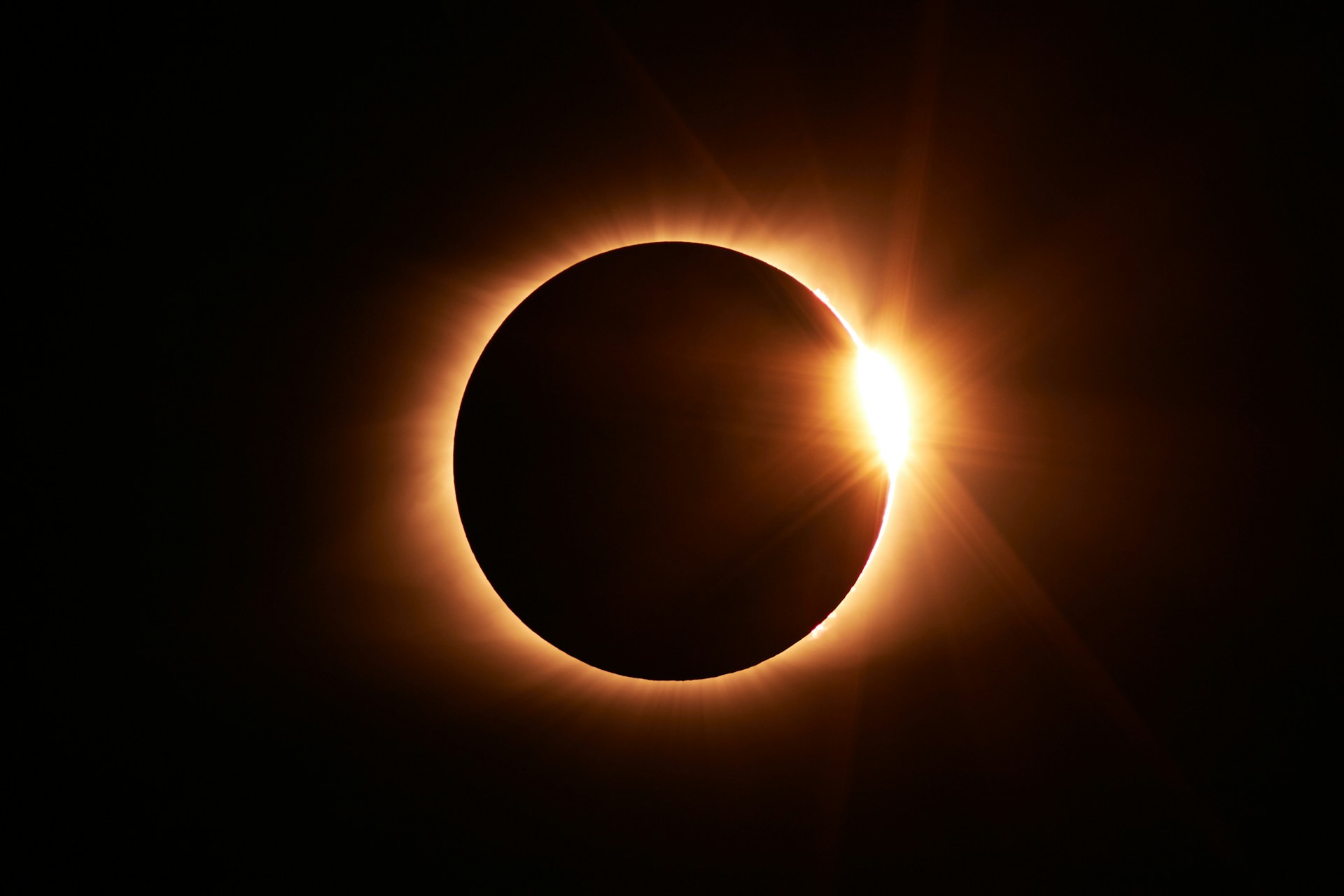
(Photo by Jongsun Lee on Unsplash)
On the evening of Wednesday, 12 August 2026, Spain will experience its first total solar eclipse in over a century — and if you’re staying in the Sitges area this summer, you’re closer to the action than you might think.
What Sitges will actually see
Let’s be upfront: Sitges itself sits just outside the path of totality. From the town, you’ll witness a dramatic partial eclipse, with the Moon covering roughly 99.7% of the Sun — nearly identical to Barcelona’s numbers. The partial eclipse begins around 19:35, reaches its near-total maximum around 20:29 with the Sun just 4° above the horizon, and ends around sunset near 20:51. Even at 99.7%, though, you won’t see the corona or experience true darkness — that missing sliver of sunlight is still dazzlingly bright, so ISO 12312-2 certified eclipse glasses are essential the entire time.
The good news: totality is a short drive away
Here’s the key detail worth knowing: the northern edge of the path of totality begins right around Vilanova i la Geltrú, just 15 minutes down the coast from Sitges. For a guaranteed, comfortable experience of full totality — complete darkness, visible stars, and the solar corona — head slightly further southwest to Tarragona or Salou, both around 45 minutes to an hour’s drive from Sitges. There, totality lasts about one minute starting at roughly 20:29 CEST. Serious eclipse chasers should continue to the Ebro Delta (about 2 hours away), where flat, open terrain delivers up to 1 minute 31 seconds of totality with some of the cleanest sea-level horizons in Spain.
Where to stand
Because the Sun will be extremely low — just 4-5° above the horizon — your view to the west-northwest matters more than your exact location within the totality band. Choose beaches, cliffs, or elevated viewpoints with a clear, unobstructed sightline toward the sea or open countryside; avoid anywhere with buildings, hills, or trees blocking the western horizon. In Sitges, the Garraf cliffs offer a clean sea view, though remember you’ll only get the partial phase there.
Some practical tips for the big day
– Beat the traffic — arrive early and plan your exit too:
Authorities across Spain are expecting significant congestion as crowds converge on the narrow totality band. In the Balearic Islands, the regional government has already announced road closures and access restrictions around 20 popular viewpoints and natural areas, active from 3pm to 9pm on eclipse day, precisely because of overcrowding concerns. Expect similar pressure on the roads toward Tarragona, Salou, and the Ebro Delta, with potential bottlenecks around Barcelona, Tarragona, Zaragoza, and Valencia as day-trippers all aim for the same coastal strip in the late afternoon. If you’re driving from Sitges, leave by early-to-mid afternoon rather than after lunch, and have a plan for getting home too — the exodus after totality, all happening within the same 20-minute window as sunset, is often worse than the arrival.
– Check the weather 24-48 hours ahead, not the week before:
Cloud cover right at the west-northwest horizon can ruin an otherwise perfect viewing spot, and forecasts this close to the coast can shift quickly. Historical cloud-cover data suggests spots like Salou (35%) and Altafulla (38%) carry moderately higher cloud risk than more open or elevated inland locations, so have a backup site in mind and be ready to reposition on the day if needed.
– Buy your eclipse glasses well in advance:
Certified ISO 12312-2 glasses tend to sell out or get marked up right before major eclipses, and counterfeit or non-compliant glasses circulate online — check for the ISO certification number printed on the frame and buy from a reputable optician, planetarium, or astronomy association rather than an unbranded marketplace listing. Bring enough for everyone in your group, since sharing one pair during the brief and fast-moving partial phase means someone misses it.
– Get there with time to spare and settle in before 20:00:
Totality itself is short (around one minute in the Tarragona area) and happens fast once the partial phase is well underway, so you want to already be parked, set up, and oriented toward the horizon at least 45-60 minutes beforehand — not still hunting for a parking spot or a clear sightline as the Moon starts covering the Sun.
– If you’re photographing it, prepare your gear beforehand:
A solar filter is mandatory on any camera or phone lens during the entire partial phase — only during the brief seconds of totality is it safe to remove it, and you need to be quick to remove and reattach the filter at exactly the right moments to avoid damaging your camera sensor or missing the shot. If you’re new to eclipse photography, mounting your phone on a small tripod with a solar viewer taped over the lens works far better than shooting handheld, and it’s worth doing a practice run on the Sun a day or two before to work out your settings.
– Other essentials:
Bring water and snacks (you may be waiting in a fixed spot for over an hour), a portable charger (networks can get congested with everyone uploading photos and videos simultaneously), and download offline maps in advance in case mobile data slows to a crawl in crowded areas.
This site is protected by reCAPTCHA and the Google Privacy Policy and Terms of Service apply.
